MessyMem:
Learning-from-Doing Memory for Mobile Manipulation

Stanford University
Accepted to Conference on Robot Learning (CoRL) 2026

MessyMem is a persistent memory system for mobile manipulation. It maintains a 3D scene graph that is globally queryable & spatially grounded, updated through interactions, and fine-grained via linked keyframes, so the robot reuses what it has learned instead of re-exploring.

Abstract

Mobile manipulators deployed across many rooms and visits should improve with experience: after discovering that a cabinet is locked or finding an object in a drawer, the robot should reuse that knowledge rather than start each task from scratch. Yet today's robots often treat each task as new: compact scene representations omit interaction-derived knowledge, raw video histories are difficult to query, and VLM planners reason at inference time without persistently updating what the robot knows.

We present MessyMem, a persistent memory system that enables mobile manipulators to learn from experience and reuse that knowledge across future tasks. It maintains a spatially grounded 3D scene graph of objects and locations, augments it with properties and outcomes learned through interaction, and links visual observations for fine-grained recall. We evaluate MessyMem in simulation and on a real mobile manipulator. In a continuous 25-task simulation spanning over 3 hours, MessyMem achieves 80.0% task progress, outperforming the strongest ablation by 14.8 percentage points and the strongest external baseline by 28.9 points, while retrieving task-relevant evidence from thousands of stored keyframes and over an hour into the past.
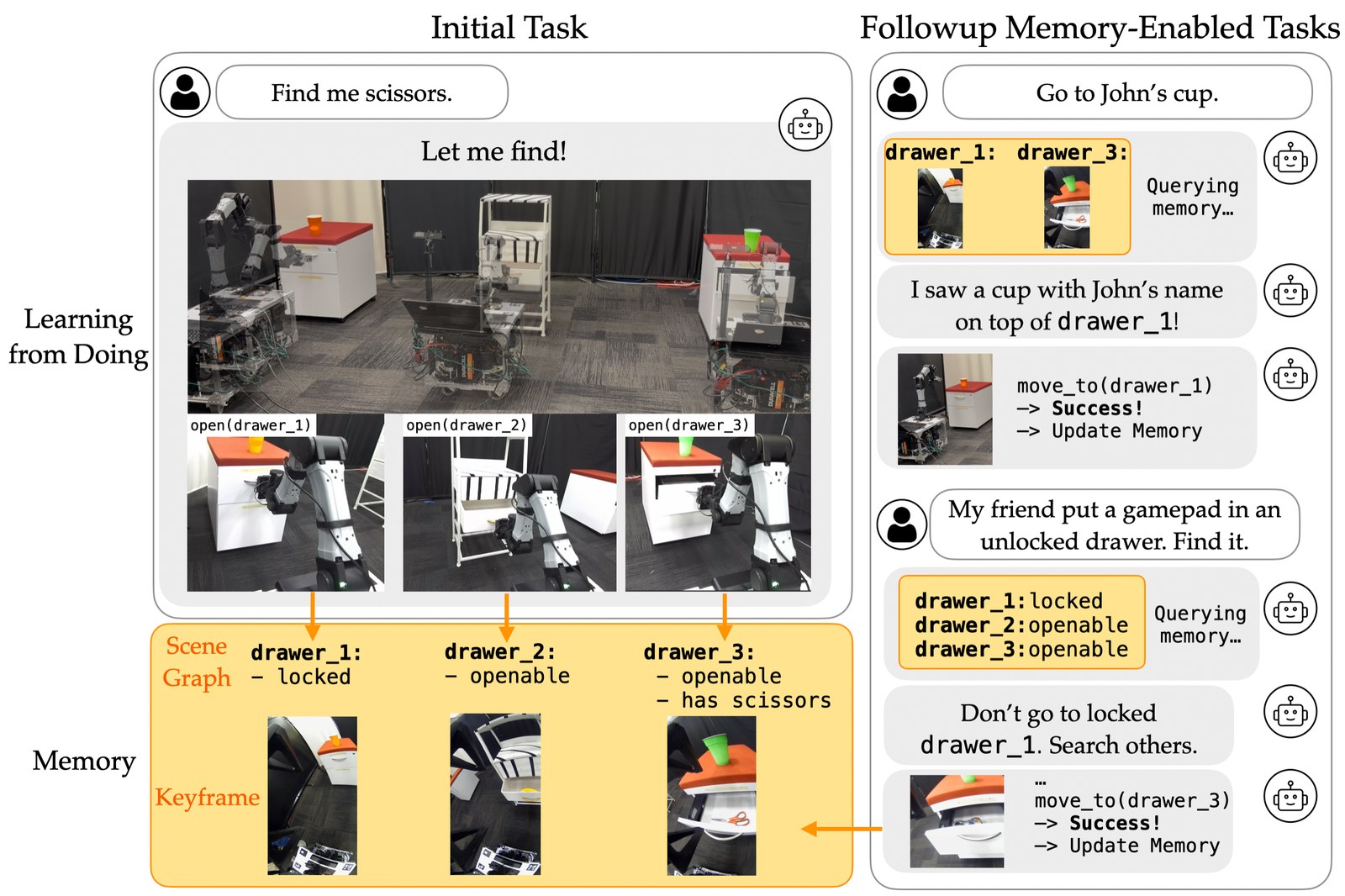
MessyMem builds memory while exploring to find scissors, then reuses it on later tasks to locate John's cup and avoid a locked drawer
(Left) The robot builds memory while exploring to Find me scissors. (Right) On later tasks it reuses that memory instead of re-exploring: fine-grained visual evidence locates John's cup, and an interaction-derived property steers it away from the locked drawer.
3+hrs of continuous operation without a memory reset
80.0% task progress over 25 long-horizon tasks
+28.9pp over the strongest external baseline

Real-World Deployment

MessyMem's memory structure allows it to be deployed in diverse real-world environments seen below. See more at Real-World Results.

Real-World Robot Platform

A TidyBot++ with a 6-DoF YAM arm and holonomic mobile base. Two ZED 2 RGB-D cameras, one on the base and one pole-mounted for a higher view, build the scene graph and localize objects in 3D. A wrist-mounted fisheye camera adds keyframe views, and wall-mounted fiducials support localization. Skills are dynamic movement primitives fit from a few teleoperated demonstrations and retargeted to each object with VLM 3D pointing.

Three Properties of Robot Memory

Memory for mobile manipulation must maintain three core properties. Prior work delivers them separately. MessyMem combines all three in one persistent store.

Spatially queryable: a map pin anchored to a ground plane

Globally Queryable & Spatially Grounded

Queries must work across rooms, floors, and sessions, in a form compact enough to actually search. Each query returns not only what the robot has seen but where to go to find it, so the planner can navigate directly instead of re-exploring.

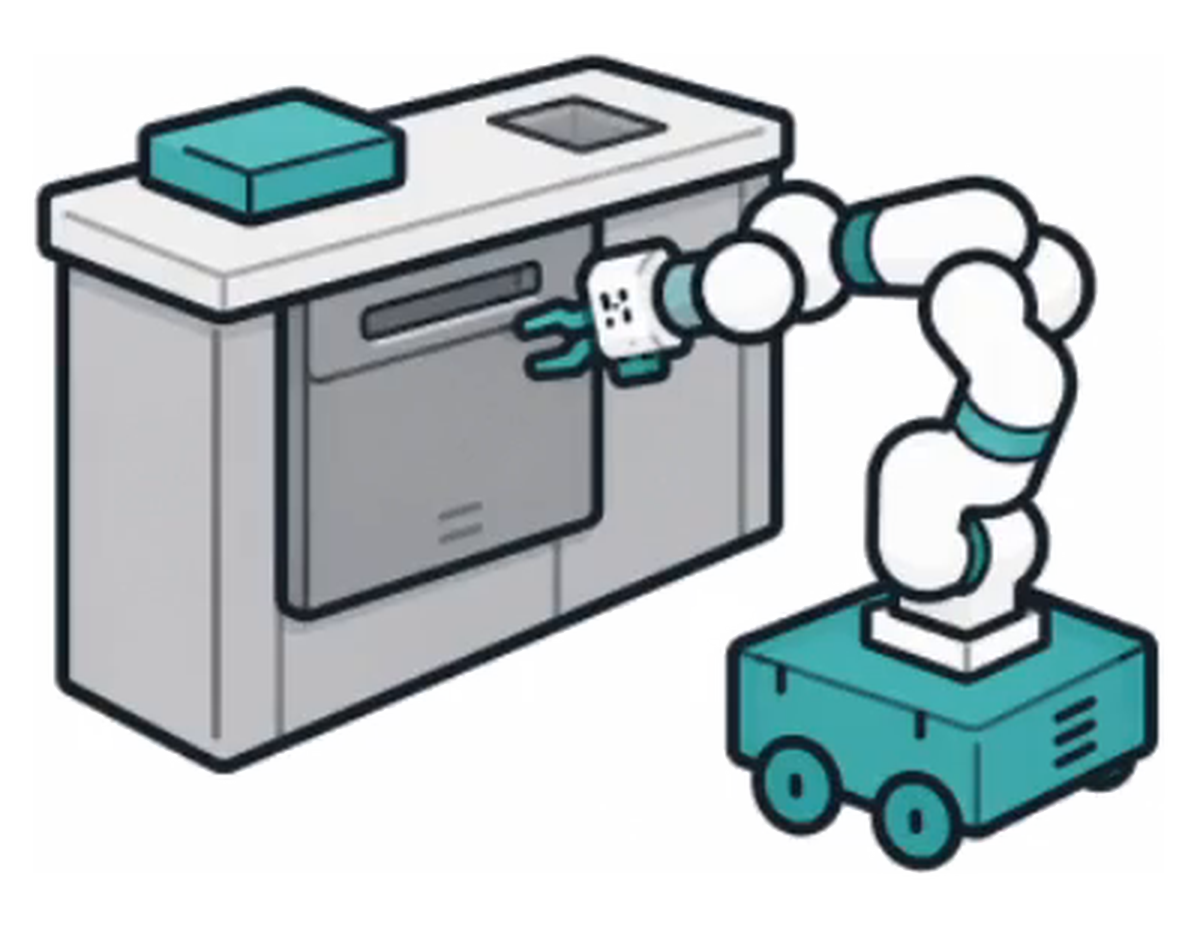
Updatable from interaction: a mobile manipulator opening a drawer

Updatable from Interactions

Many properties, such as weight, emptiness, articulation, and whether a cabinet is locked, cannot be inferred from passive observation and must be learned by acting. Memory has to record what each interaction reveals, including why an attempt failed.

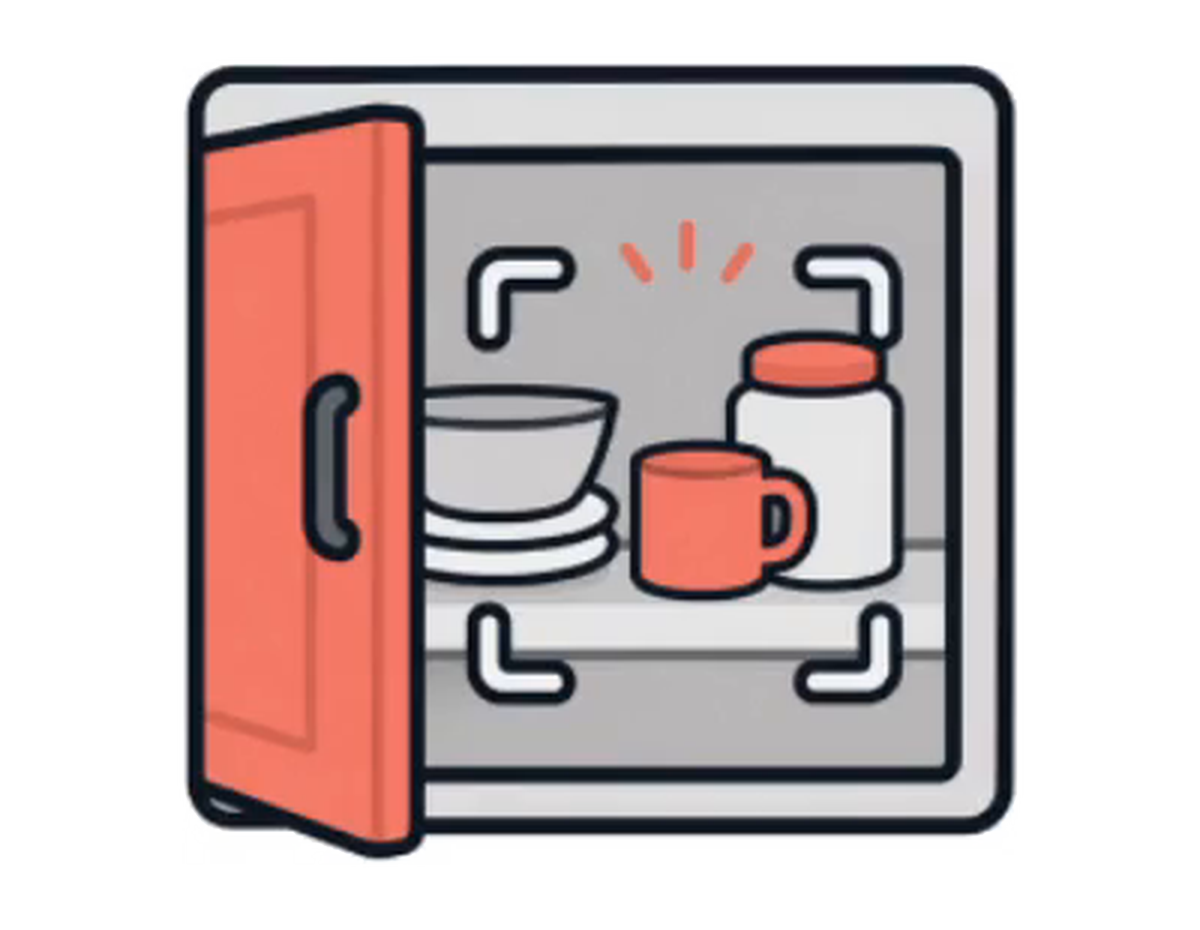
Fine-grained: a cabinet interior with keyframe focus brackets

Fine-Grained

Text summaries alone are often insufficient. The robot must retrieve visual context on demand: the exact shelf where coffee was last seen, the name printed on a particular cup, or how cluttered one cabinet is compared to another.

Method Overview

Memory is built from RGB-D observations and manipulation outcomes, and used in a closed loop: every planning step retrieves against the latest memory.

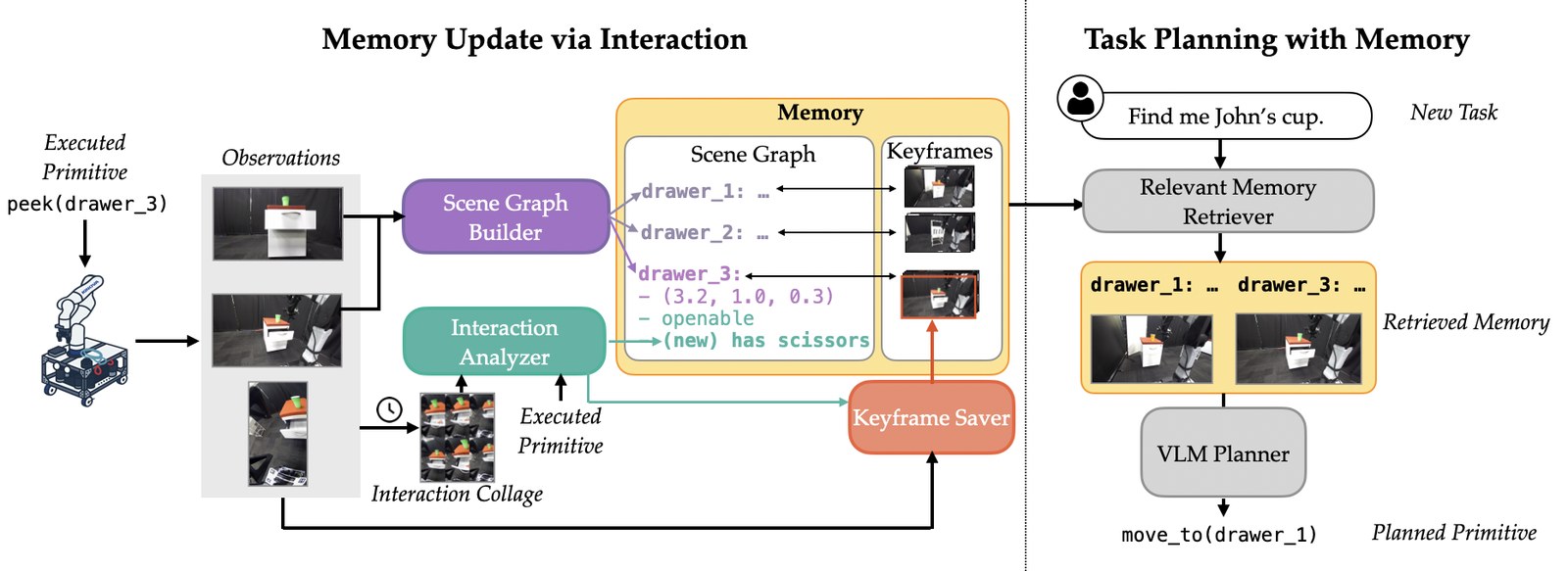
MessyMem architecture: a scene graph builder, keyframe saver and interaction analyzer update memory, while a memory retriever and VLM planner consume it
(Left) The scene graph builder, interaction analyzer, and keyframe saver write to one persistent memory. (Right) At each step, the retriever surfaces relevant properties and keyframes for the VLM planner.

The Execution Loop

  1. 1Retrieverelevant memory
  2. 2Plannext primitive
  3. 3Executeon the robot
  4. 4Analyzeinteraction window
  5. 5Updatescene graph + keyframes

the next planning step retrieves against the newly updated memory

Scene Graph Builder

SAM3 segments each RGB-D frame, masks are lifted to 3D with depth, and same-label detections merge into persistent object nodes. Each node keeps an id, a 3D centroid, and a property dictionary, and stays in memory after leaving view.

Interaction Analyzer

After each manipulation, a VLM reads a multi-frame collage of the action and writes structured updates to the target node: properties like openable, fixture contents, and success or failure with a reason. Newer evidence overwrites stale values.

Keyframe Saver

Saves the frames before, after, and most informative in each manipulation, plus a frame whenever the graph changes. Each is linked to its scene-graph nodes with metadata and analyzer labels, and near-duplicates are filtered out.

Memory Retriever & VLM Planner

The retriever pools candidate keyframes from three sources: frames linked to scene-graph nodes, frames whose analyzer labels match the task, and recent interaction frames. Per-source caps keep recently seen objects from crowding out the rest.

Retrieval then runs in two stages: a text-only pass shortlists frames from their metadata, and a multimodal pass inspects thumbnails to keep a small, non-redundant set. The planner combines these with the scene graph and current view.

Memory in Action

A walkthrough of the three memory properties, followed by the robot building and querying memory during a task.

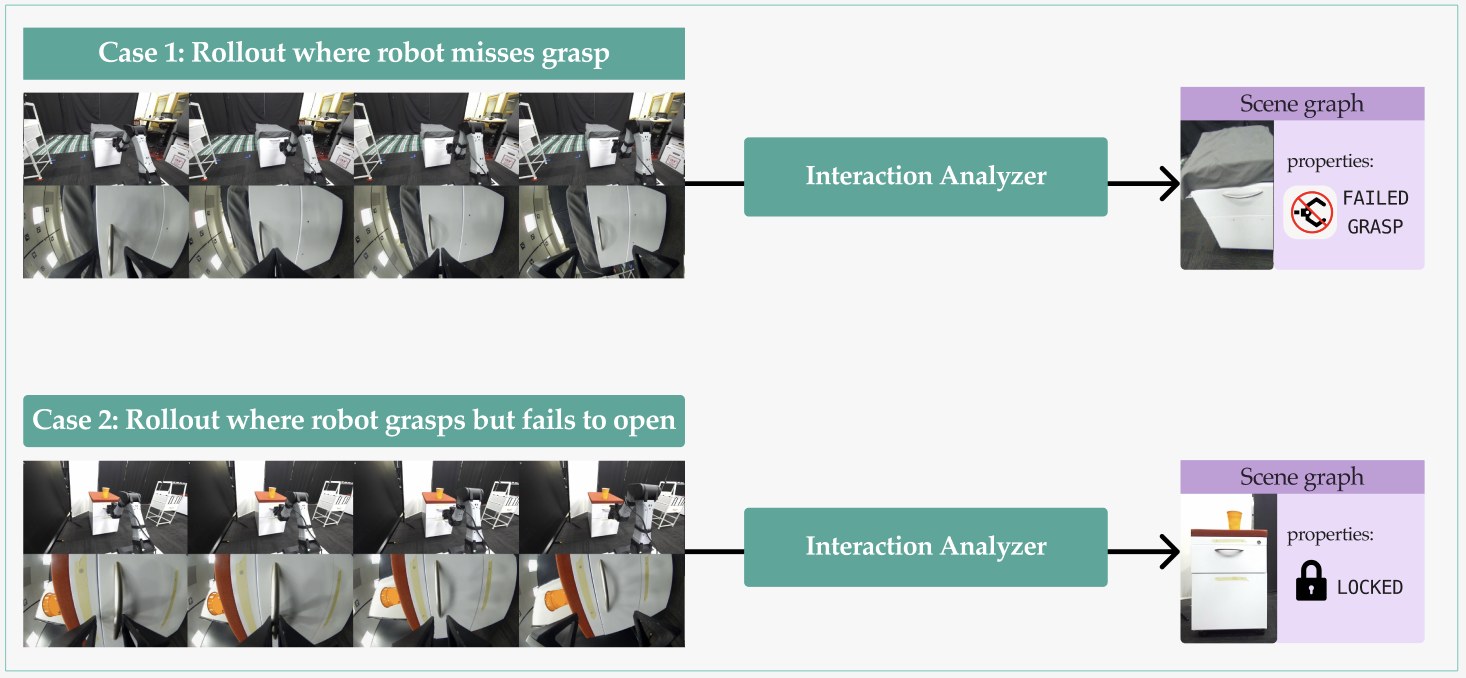
Interaction collage distinguishing a failed grasp from a locked cabinet
The collage separates a failed grasp (the gripper misses the handle) from a locked cabinet (the gripper holds and pulls, but nothing moves). One means retry; the other means move on.
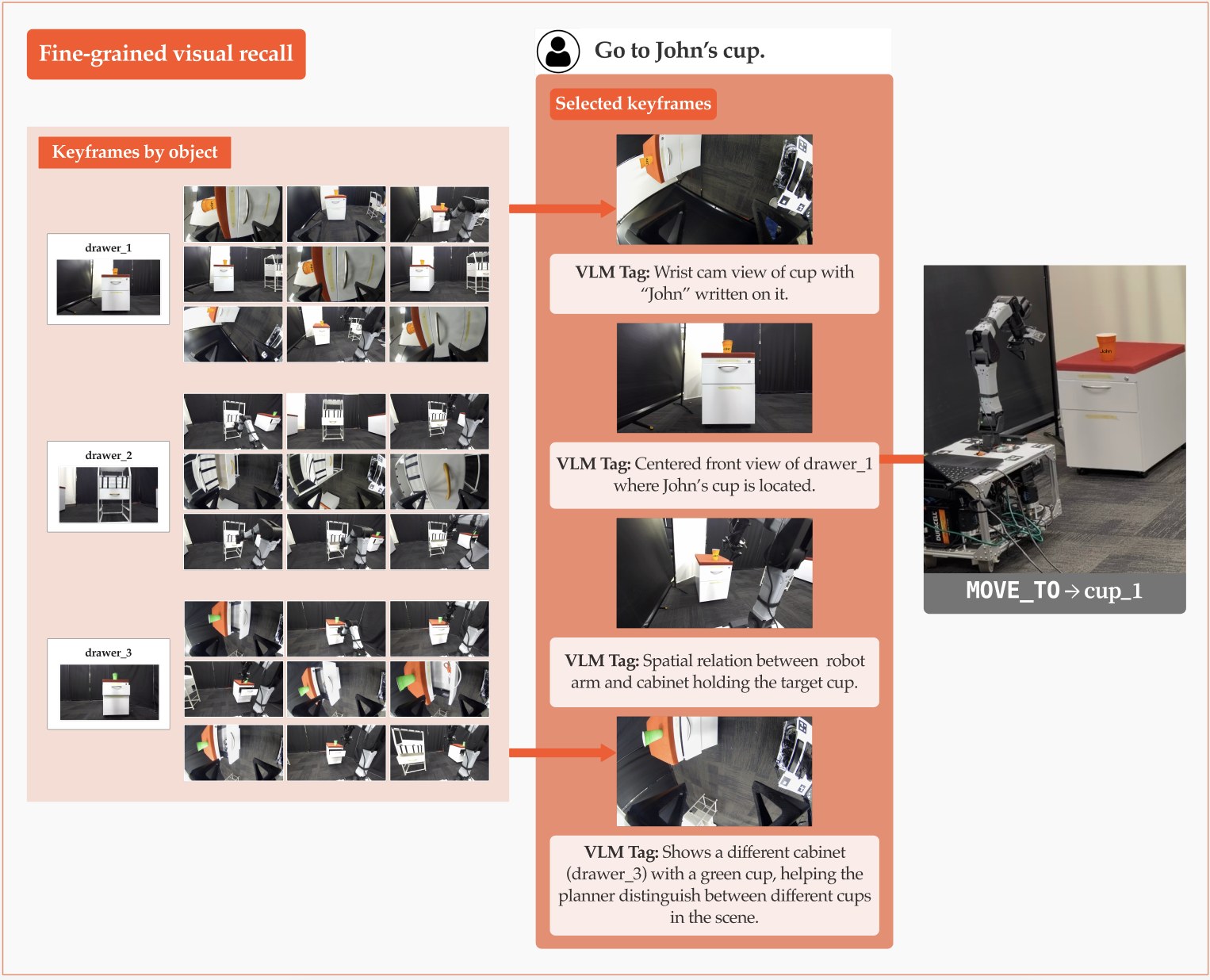
The retriever selects keyframes showing an orange cup and a green cup to identify John's cup
For go to John's cup, the retriever surfaces frames of both cups, so the planner can pick the orange cup labeled “John”, a detail the scene graph never stored.

Experimental Setup

All methods share the same planner, perception, and primitives, so differences come from memory alone.

Initialization

Each trial starts by viewing fixture locations. Their contents stay hidden until the robot interacts.

Task Sequence

Tasks arrive one at a time, so what the robot learns early must persist.

Primitives

Shared across methods, with a budget of twelve planner calls per task.

Metrics

Task progress and action count, over 50 trials per method (in simulation) with 95% CIs.

Compared Methods

Ours & ablations
  • MessyMem (SG + IA + KF): the full system.
  • SG + IA: no keyframes.
  • SG + KF: no interaction analyzer.
  • SG: object labels and positions only.
External baselines
  • RoboEXP: an action-conditioned scene graph with predefined relations and no keyframes.
  • MemER-style: episodic keyframe memory without a persistent scene graph.
  • MemER + Fixtures: MemER-style plus fixture identities and positions.

Simulation

Scenarios run in the MuJoCo-based RoboCasa365 simulator, with a Franka Panda arm on an Omron mobile base.

Long Horizon: 25 Tasks, 3+ Hours

Globally queryable Updatable from interactions Fine-grained

25 consecutive household tasks in a 10-cabinet kitchen with more than 60 objects and fixtures, run for over three hours without resetting memory or the environment. Three cabinets are locked. An initial teapot search encourages exploration; later tasks reuse earlier observations across four task families.

Family 01

Finding (9 tasks)

Locate objects using remembered locations, neighboring items, or accessibility.

Example finding a stored mug among countertop distractors

Family 02

Matching (9 tasks)

Identify a specified object instance or match a countertop reference using visual details from earlier observations.

Example distinguishing cereal brands, even when Corn Flakes is stored in the fruit cabinet

Family 03

Manipulation (3 tasks)

Select a storage destination for bread, a mug, or a bowl using remembered cabinet contents, without transporting the object.

Example choosing the pantry cabinet for bread based on its dry goods

Family 04

Memory Queries (4 tasks)

Recall earlier contents and spatial relationships. These questions can be answered from existing memory without further exploration.

Example recalling which objects were stored with the mayonnaise

Panorama of the ten-cabinet long-horizon kitchen with an inset showing one cabinet interior

Locked-and-Unlocked Cabinets

Globally queryable Updatable from interactions

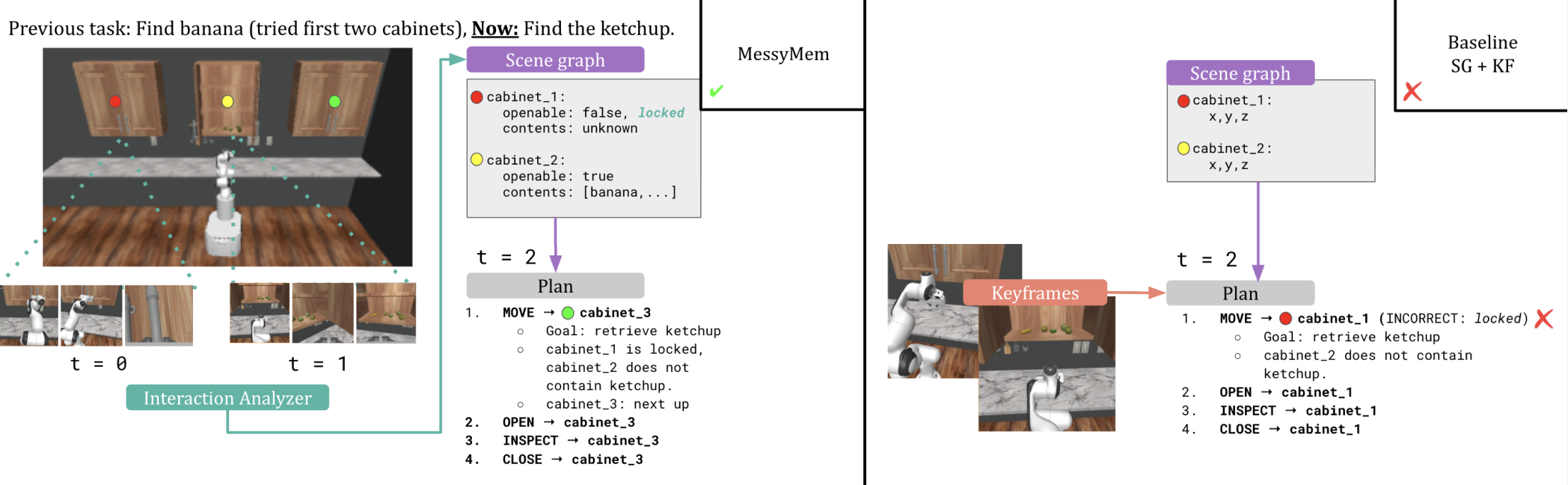
First Find bananaThen Find ketchup

Cabinet 1 Locked Failed to open Skip
Cabinet 2 No ketchup Banana found Skip
Cabinet 3 Unexplored Next to search Go here →
Remember the failed interaction. Skip the locked and already-searched cabinets.

MessyMem stores the lock state → goes to cabinet 3.

SG + KF retries the locked cabinet → task failure.

Expand for the full figure

Clutter-Aware Pick

Globally queryable Updatable from interactions Fine-grained

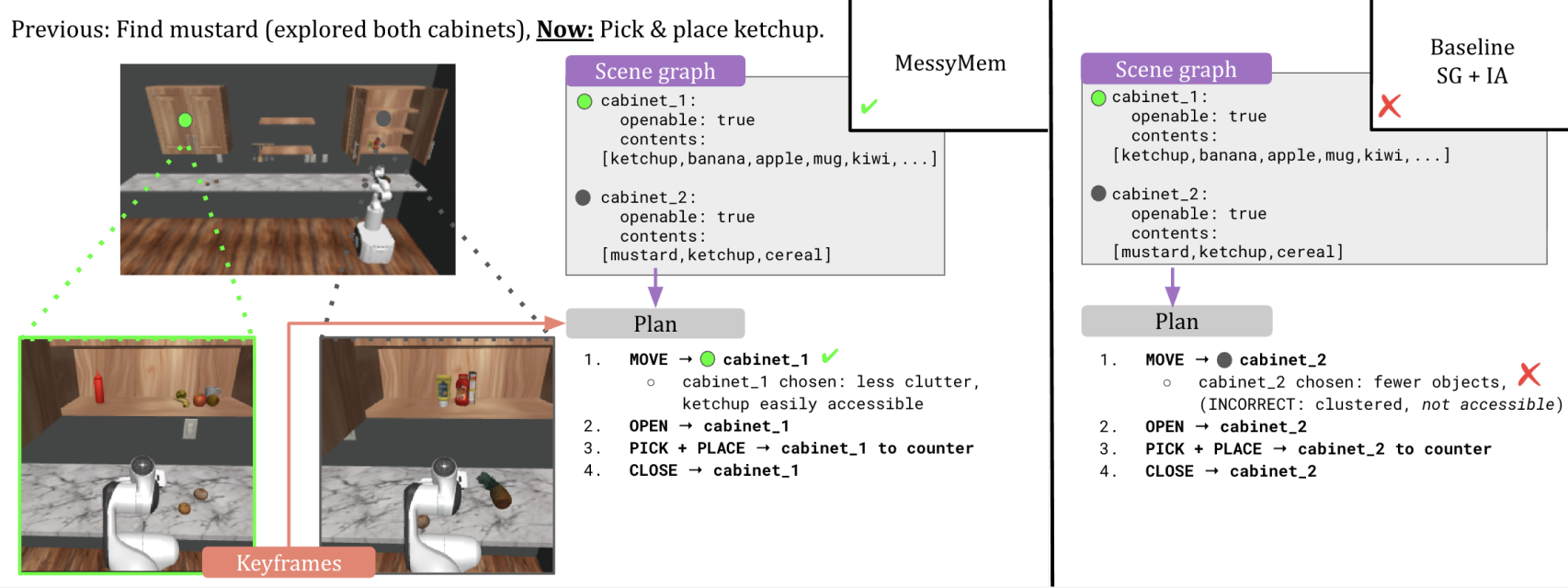
First Find mustardThen Pick & place ketchup

Cabinet 1 Accessible ketchup 6 items · clear side access Pick here →
Cabinet 2 Wedged ketchup 3 items · blocked side access Skip
Recall the layout, not just the count. Both hold ketchup; fewer items can still mean less access.

MessyMem compares stored keyframes → picks from cabinet 1.

SG + IA relies on item counts → picks the obstructed bottle.

Expand for the full figure

Results

MessyMem achieves the highest task progress in all three simulated evaluations, and no single memory component suffices on its own.

Task Progress by Scenario

Mean task progress (%) over 50 trials per method; whiskers show the 95% confidence interval. Bar shade encodes how many of MessyMem's three memory components a method has; external baselines are shown in grey.

All three components Two components One component External baseline
View as table (with 95% confidence intervals)
Mean task progress with 95% confidence intervals over 50 trials per method.
Method Cluttered Pick Locked / Unlocked 25-Task Long Horizon
MessyMem (Ours)84.0 [77.0, 90.0]99.0 [97.0, 100.0]80.0 [77.4, 82.6]
SG + IA58.0 [53.0, 63.0]88.0 [82.0, 94.0]65.2 [63.5, 67.0]
RoboEXP53.0 [48.0, 58.0]70.0 [63.0, 76.0]51.1 [49.1, 53.1]
SG49.0 [45.0, 53.0]50.0 [50.0, 50.0]49.1 [47.4, 51.0]
SG + KF51.0 [44.0, 58.0]43.0 [35.0, 51.0]47.9 [45.5, 50.4]
MemER-style0.0 [0.0, 0.0]0.0 [0.0, 0.0]1.8 [1.0, 2.5]
MemER + Fixtures8.0 [3.0, 13.0]27.0 [16.0, 39.0]0.7 [0.3, 1.2]

Fine-grained memory enables instance-level reasoning

On Cluttered Pick, MessyMem reaches 84% vs 58% for SG + IA and 51% for SG + KF. Without keyframes, the robot knows where ketchup was seen but not which bottle is reachable.

Interaction-derived memory captures outcomes

On Locked / Unlocked, MessyMem reaches 99% and SG + IA 88%, vs 43% for SG + KF. A saved image cannot tell a locked cabinet from a failed grasp; the analyzer can.

External memory systems fall short

RoboEXP's predefined relations miss fine-grained appearance and learned state like a locked cabinet. MemER-style memory loses track once fixtures leave view; adding fixture positions only lifts it from 0% to 8% and 27%.

Memory Remains Useful as It Grows

Over three hours of continuous operation, the goal and scene-graph links narrow thousands of keyframes to a small candidate set before visual reranking, so older experience stays reachable as memory grows.

9,669 median keyframes accumulated
8.6s median retrieval latency
62.7min median lookback into the past

All six paired comparisons are significant after Holm correction (pHolm < 10−4). MemER's recency bias buries older evidence, and RoboEXP's relations cannot tell Froot Loops from a visually similar Trix box.

Real-World Results

MessyMem reaches 1.00 task progress in both scenarios, while each ablation fails in its own way.

Office Drawer Search

Globally queryable Updatable from interactions Fine-grained

Three drawer units, one locked. The robot finds scissors, moves to John's cup, then finds a controller newly placed in an unlocked drawer. MessyMem is the only method to complete all three goals, in 10.8 steps with an SPL of 0.92, the closest to the optimal path.

Office Drawer Search: task progress, executed steps, and SPL for each sequential goal and overall.
Method 1: “Find Scissors” 2: “Move to John's cup” 3: “Find placed controller” Overall
Prog. ↑Steps ↓SPL ↑Prog. ↑Steps ↓SPL ↑Prog. ↑Steps ↓SPL ↑Prog. ↑Steps ↓SPL ↑
MessyMem (Ours) 1.006.40.85 1.001.20.90 1.003.21.00 1.0010.80.92
SG + IA 1.006.60.90 0.601.40.60 1.003.00.96 0.8711.00.82
SG + KF 0.807.40.67 0.603.60.34 0.406.00.19 0.6017.00.40
SG 0.009.40.00 0.201.00.20 1.005.00.81 0.4015.40.34

SPL is success weighted by path length, against human-annotated optimal step counts of 6, 1, and 4 for the three goals. Overall steps are summed across the trial.

Sock Pairing

Globally queryable Updatable from interactions Fine-grained

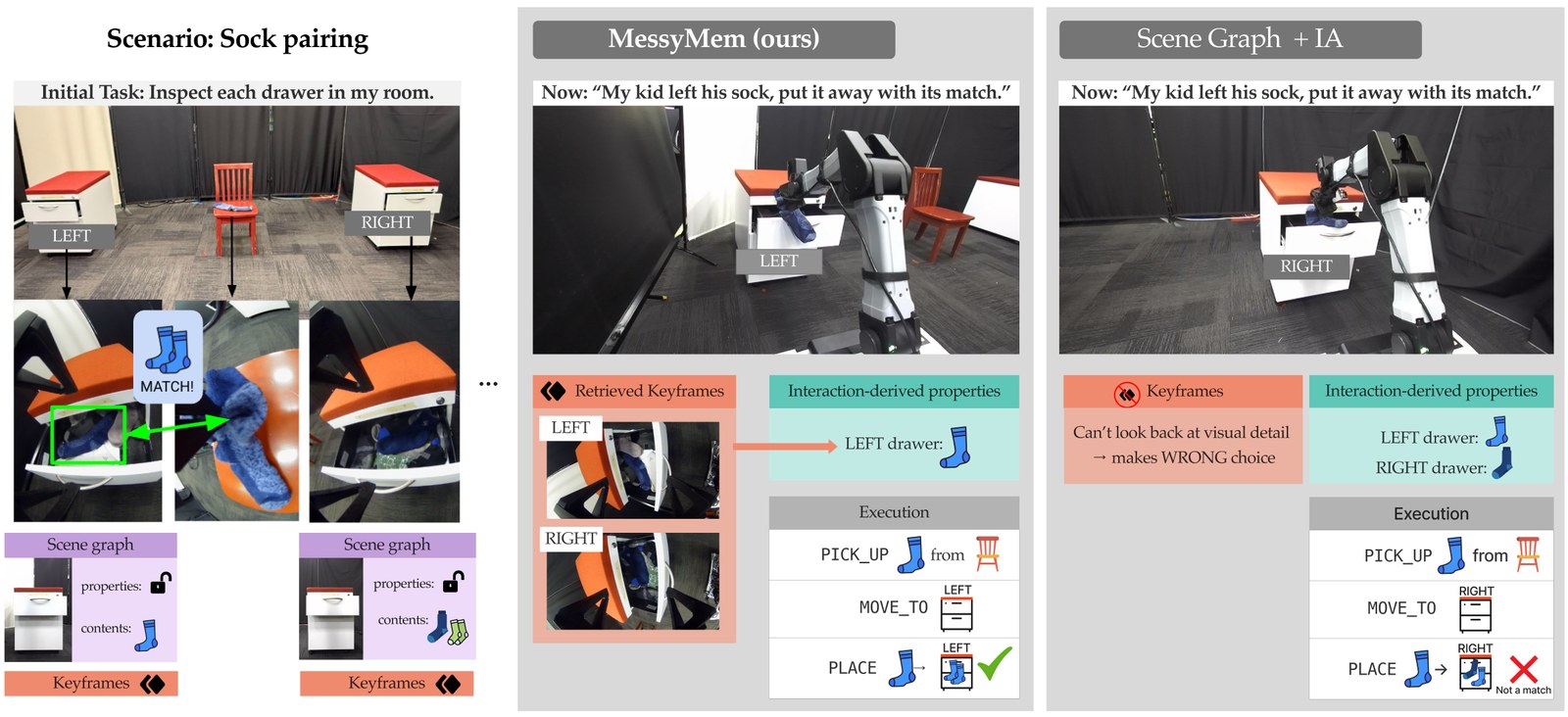
Two drawers of socks and a loose sock on a chair. After inspecting both drawers, the robot must put the loose sock with its match, which differs from the others mainly in color or pattern. The match is randomized each trial, so the answer cannot be memorized.

Task progress on Sock Pairing.

MessyMem retrieves drawer-interior keyframes to match the loose sock, while SG+IA selects the wrong drawer

Limitations & Future Work

  • Closed-set detection. Object detection uses a fixed prompt set; open-vocabulary detectors would let memory capture more objects and attributes.
  • Robot-initiated actions only. The analyzer reasons about the robot's own actions; extending it to human actions would open up HRI settings.
  • Richer primitives. The same memory interface could drive more expressive policies, including VLAs.

BibTeX

@inproceedings{banwasi2026messymem,
  title     = {MessyMem: Learning-from-Doing Memory for Mobile Manipulation},
  author    = {Banwasi, Anuva and Muckelroy III, William and Sundaresan, Priya
               and Zhao, Linfeng and Bohg, Jeannette and Ho, Cherie},
  booktitle = {Conference on Robot Learning (CoRL)},
  year      = {2026}
}

Acknowledgements

This work is supported by the Toyota Research Institute. We thank Marlowe for robust infrastructure for training robot learning policies. Priya Sundaresan is supported by an NSF GRFP. Cherie Ho is supported by the Croucher Postdoctoral Fellowship. Thank you to Satvik Sharma and Francis Engelmann for helpful discussions. We thank Alberta Longhini, Tyler Lum, and Carlota Parés-Morlans for feedback on earlier drafts of the paper.

The views and conclusions contained herein are those of the authors and should not be interpreted as necessarily representing the official policies, either expressed or implied, of the sponsors.